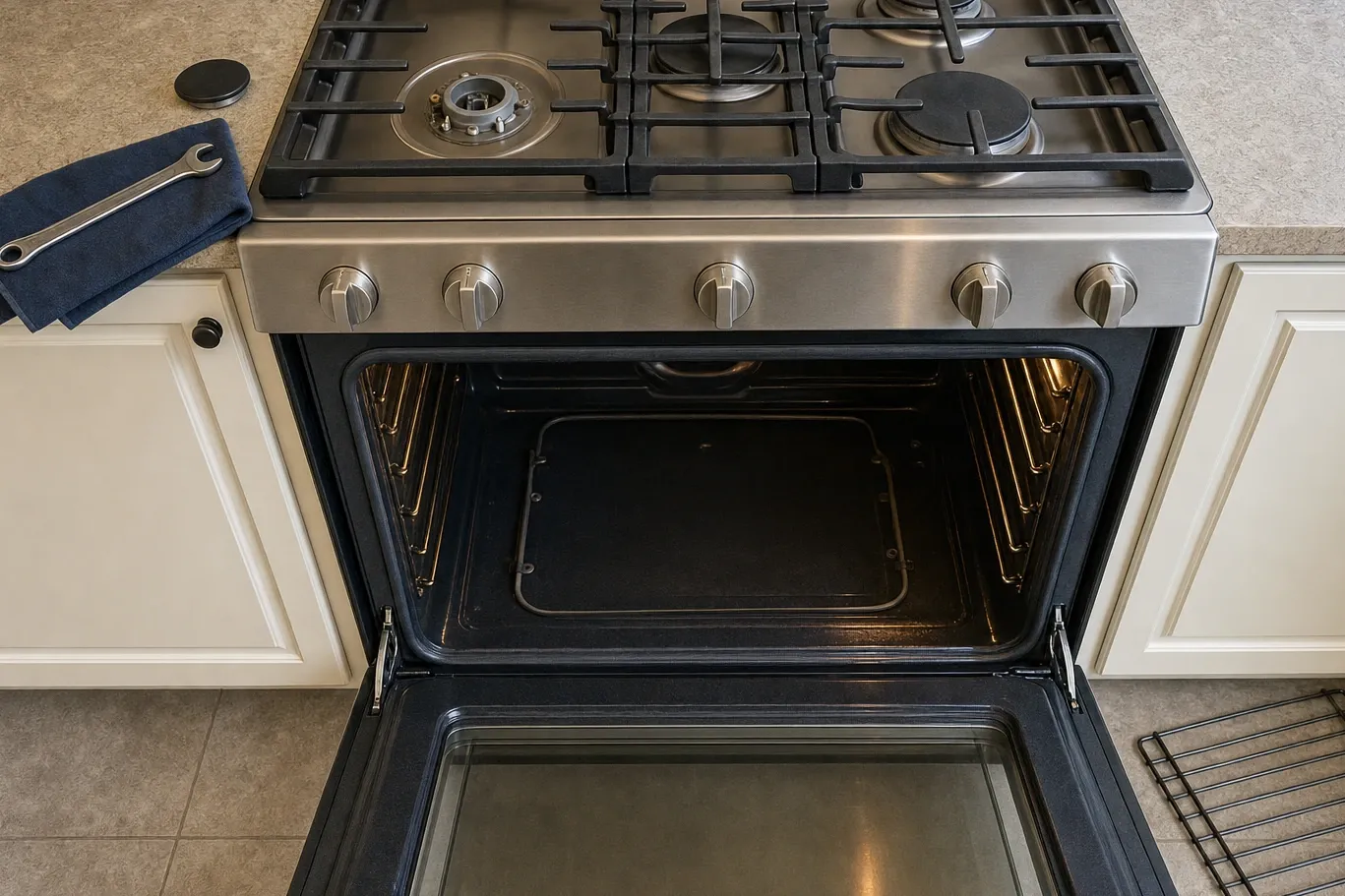
Wolf Range Maintenance: The Care Routine That Stops the Clicking
Wolf range maintenance is a short, regular routine: wipe spills once the burners cool, wash grates and caps at the sink weekly, keep igniters dry and grease-free, wash hood filters monthly and hand-clean the oven before running Clean. Here is the full schedule.
Written byDesmond AchebeCooking-appliance technician — controls and fault codes · 11 years in the trade

Wolf range maintenance is a short routine done often rather than a big job done rarely. Wipe spills once the burners have cooled, wash the grates and burner caps at the sink each week, keep the igniters dry and free of grease, wash the hood filters once a month, and scrub the oven by hand before you ever start a Clean cycle. Ranges in Denver homes sit at about 5,280 feet, where gas appliances are commonly adjusted for thinner air, so a weak or yellow flame right after cleaning is worth checking against a crooked cap or a blocked port before you blame the altitude setup. Our guide on why a Wolf simmer runs hot here covers that side of things.
After every cook: spills, the panel and the charbroiler
Let the burners cool, then wipe up anything that boiled over. A spill that dries inside the burner base is what later blocks the ports and wets the igniter.
The control panel needs a little care of its own. On a dual fuel model, touch and hold Lock for 3 seconds first so a stray wipe cannot switch anything on, then spray degreaser onto a cloth rather than straight onto the panel.
If your range has a charbroiler, leave it running for 10 minutes after you finish cooking so the drippings burn away. Once the grate is cold, drape wet towels over it, soak it with hot water, then scrub. That grate can also go through the dishwasher.
Weekly: grates, burner caps and knobs
Burner grates go to the sink, not into a tub. Wolf’s guidance is hot water with mild detergent, or a baking soda paste for stubborn spots, without submerging the grates. Control knobs get a wipe with a damp cloth and never go in the dishwasher.
While the grates are off, lift each burner cap and wash it the same way. Look at the ports around the burner head: if any are clogged with burnt sugar or sauce, clear them with a straight pin or an opened paper clip. Avoid wooden toothpicks, which snap off inside the port. Dry every piece completely, then set each cap back so it sits flat and centered with no rocking. A cap that is even slightly off is the easiest way to get uneven flames or a burner that refuses to light.
A griddle, if you have one, needs an occasional deeper clean. Strip the old seasoning with 1/2 cup (120 ml) of warm water and 1 teaspoon (5 ml) of griddle cleaner, push the loosened residue into the grease tray, and oil the plate again once it is dry.
Igniters: why a Wolf burner clicks but won’t light
The small ceramic igniter beside each burner throws the spark. When it is visibly coated, brush it gently with a soft-bristle toothbrush and let it dry. An igniter that is cracked, broken or loose is past cleaning and has to be replaced.
When a burner clicks but does not light, the spark is working and something else is in the way. Check these in order:
- The cap is not seated, so the gas and the spark miss each other.
- Ports near the igniter are blocked, so no gas reaches the spark.
- The igniter is greasy or damp, and the spark is too weak to catch.
When a burner keeps clicking and won’t stop, moisture is the usual culprit, often from a boil-over or a recent wash. Turn the knob off, take the cap off and give the burner a few hours to dry out. If the clicking carries on with every knob off and everything dry, a valve switch or the spark module has likely failed. That repair typically runs $180–$470 depending on the part, and you can see where these components sit on our page showing what is inside a Wolf dual fuel range.
Monthly: the hood filters
The hood catches grease that would otherwise settle on your cabinets, and its filters load up faster than most people expect. Pull the filters once a month and wash them in hot soapy water or, if they are stainless baffles, in the dishwasher, then let them dry before refitting.
Before you run Clean on the oven
Self-clean works best on an oven that is already mostly clean. Start by easing off crusted spills using a razor blade held flat, and follow with a soapy-water wash of the whole interior. Chemical cleaner left on the porcelain can etch it once the cycle heats up, so rinse thoroughly. When the cycle has finished and the oven is cool, wipe out the ash with a damp cloth.
Leave the door gasket alone. Wolf specifically tells owners not to clean it, because rubbing or shifting it can spoil the seal. Clean the glass and the frame around it instead.
Expect some fine lines in the porcelain over the years. Heating and cooling make the enamel expand and contract, and self-clean is especially hard on it, which can leave a cloudy look that shows most in a colored cavity. It is cosmetic, but it is also a good reason to run Clean a few times a year rather than after every roast.
A schedule you can stick to
| When | What to do |
|---|---|
| After each use | Wipe spills once cool; burn off the charbroiler for 10 minutes |
| Weekly | Wash grates, caps and knobs; check that caps sit flat |
| Monthly | Wash the hood filters; brush the igniters |
| A few times a year | Hand-clean the cavity, then run Clean |
When the routine is not enough
Some symptoms are repairs rather than upkeep: no spark at all on one burner, a cracked igniter, a flame that stays uneven after a careful cleaning, or an oven door that lets heat escape. If you ever smell gas, do not try to light a burner; turn the knob off, open a window and call your gas utility from outside the house.
Burner valve or orifice work typically falls in the $240–$560 range, and a door hinge, glass or seal repair usually lands between $270–$700. Every visit starts with a flat $89 that pays for the trip out and the whole diagnosis; say yes to the work and that $89 is deducted from what you owe. The firm price is set after diagnosis, and our Denver repair cost page lists the other common jobs. We cover Sloan’s Lake, Baker, Hilltop and Bonnie Brae, and you can reach us by phone at (720) 649-6641 or book a visit from this page.
Follow-ups
- Why does my Wolf stove click but not light?
- Usually the spark is fine but it is not meeting the gas: a burner cap sitting off-center, ports clogged with dried boil-over, or an igniter coated in grease. Reseat the cap, clear the ports with a straight pin, let everything dry and try again. If there is no spark at all or the igniter is cracked, it needs a repair.
- Why won't my Wolf range stop clicking?
- Moisture is the most common reason, usually from a spill or a fresh wash reaching the igniter or the switch behind the knob. Switch the burner off, take the cap off and give the head several hours to dry out. Should the clicking carry on with every knob off and everything dry, the spark module or a valve switch has probably failed.
- Can Wolf burner grates go in the dishwasher?
- No, the burner grates should be scrubbed at the sink with hot water and mild detergent, or a baking soda paste, without soaking them under water. The charbroiler grate is the exception and is dishwasher safe. Control knobs only ever get a wipe with a damp cloth.
- What does a Wolf range igniter repair cost in Denver?
- An igniter or spark module repair typically runs $180–$470, depending on which part has failed and how many burners are affected. The firm price comes after diagnosis, and the flat $89 visit, which covers the trip and the diagnosis, is credited toward the repair once you approve it.
- Should I clean the gasket on my Wolf oven door?
- No, leave it alone. Wolf tells owners not to clean the door gasket, because rubbing or moving it can weaken the seal. Clean the glass and the frame around it instead, and if the gasket is torn, flattened or letting heat out, have it replaced.